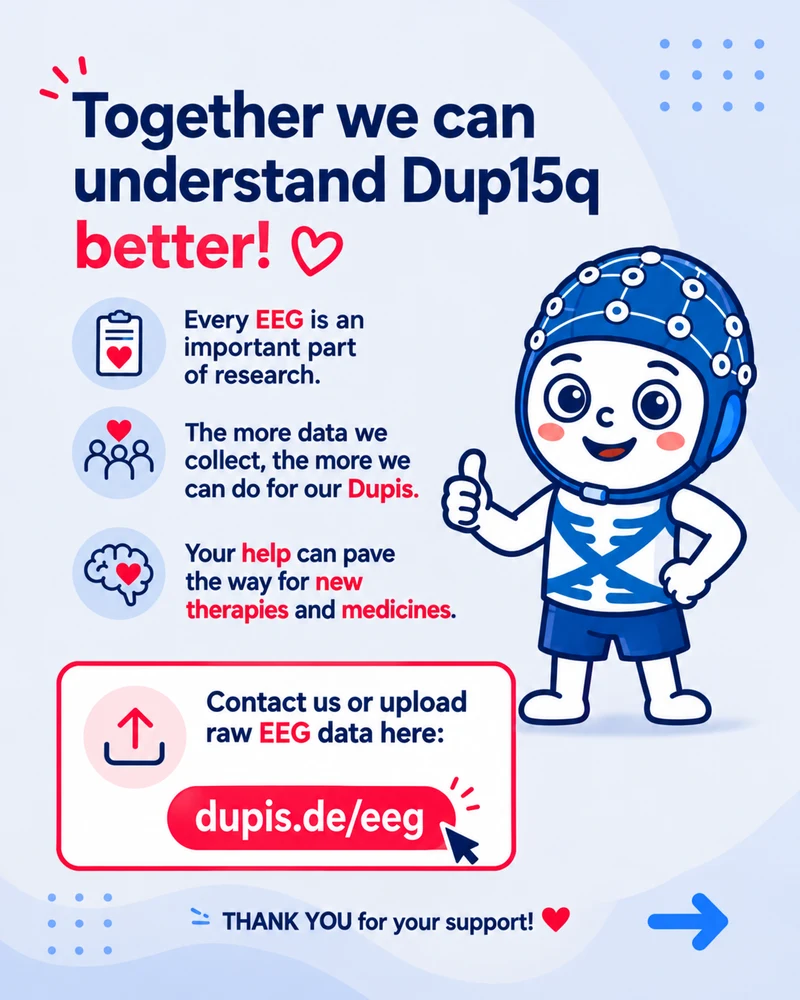
The upload link leads directly to Heidelberg University Hospital’s secure data area.
If your hospital is reluctant to release EEG data, you can use this template to request them.
Data request template · Version 6 October 2026. Please complete your child’s details and the treating institution’s information.
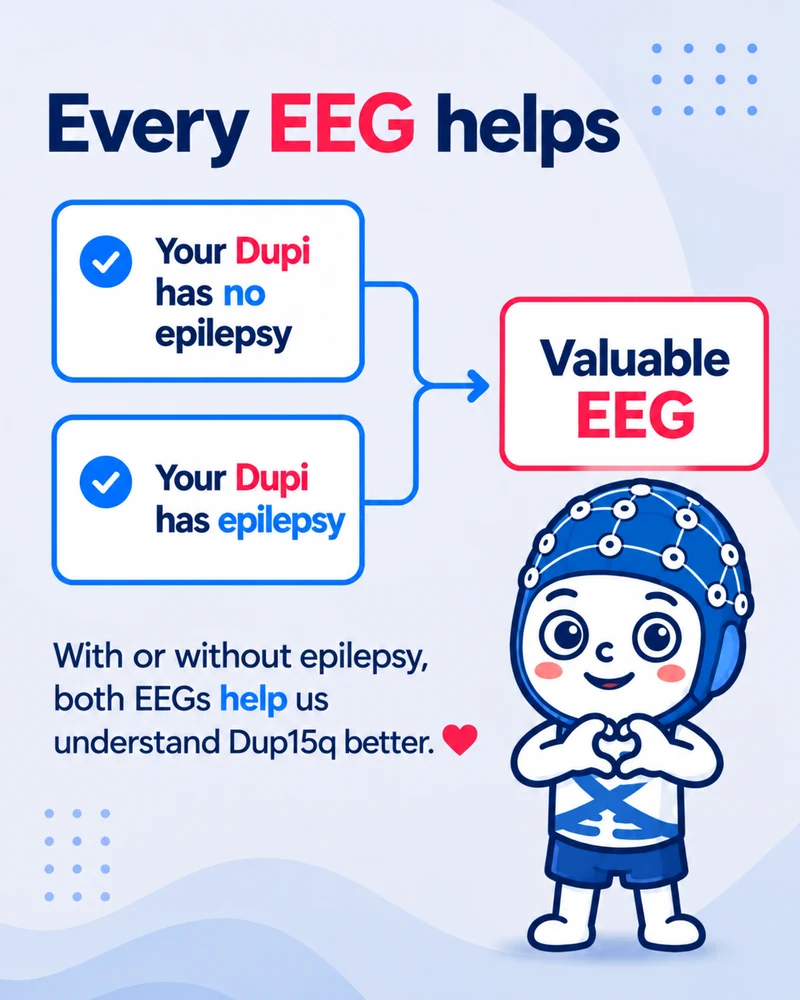
Every EEG helps
Swipe right or use the arrow keys to browse
What is the study about?
The study investigates EEG characteristics and epilepsy in people with Dup15q syndrome. Information from the Dup15q registry is linked with EEG recordings.
The focus is on a more detailed description of an EEG feature already reported in scientific studies. This feature could help with diagnosis and treatment of Dup15q syndrome.
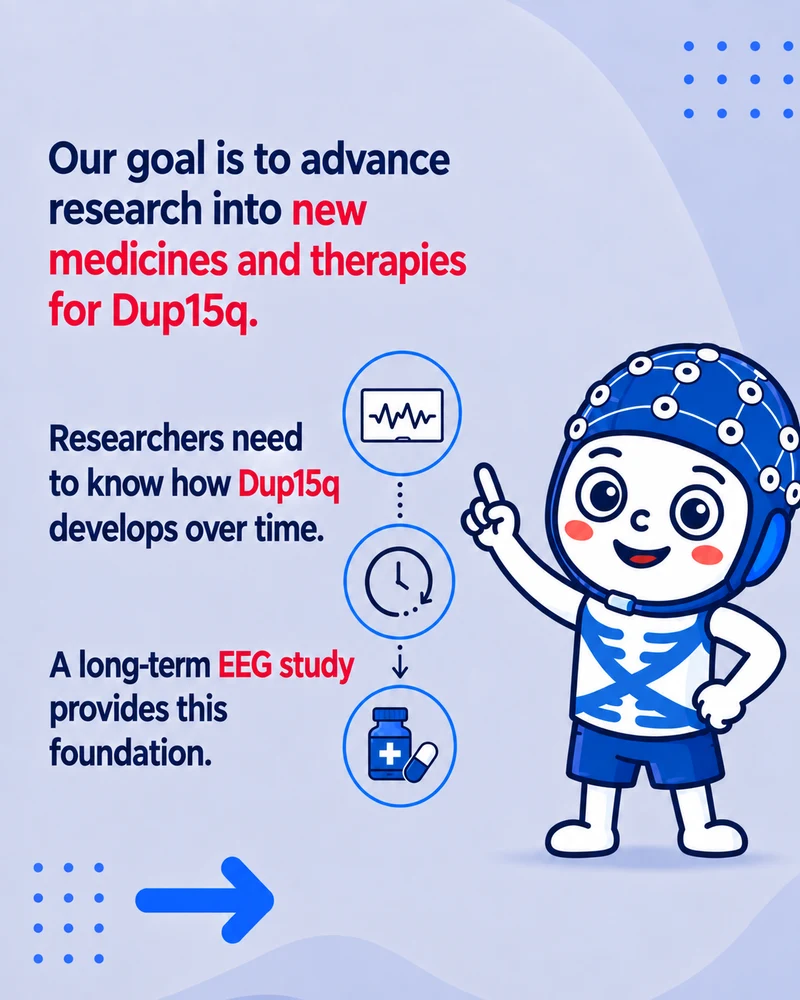
Only a small number of EEG recordings are currently available for the longitudinal study. To better understand Dup15q, researchers need much more data from different age groups and, where possible, multiple points in time.
The data gap at a glance
60patients with available EEG data
5,564estimated people with Dup15q in Germany
Numerical size comparison1.08%
For scale: the number of patients with EEG data is numerically 1.08% of the estimated number of people with Dup15q in Germany. This estimate refers exclusively to Germany.
Following people over time helps reveal how Dup15q syndrome and possible epileptic changes develop throughout life. Every additional EEG, with or without epilepsy, is therefore valuable.
These findings provide an important basis for further research. In the future, they may help develop more targeted therapies and new medicines for people with Dup15q.
How to take part
1
Request all raw EEG data
Ask hospitals and neurologists for as many of your child’s existing EEG recordings as possible. We need the recording data (raw data), not just written reports. If obtaining the data is difficult, use our data request template.
2
Send EEG data: two options
Choose whichever option works best for you. People with Dup15q can participate regardless of their country of residence.
Upload directly using the link
Where possible, combine the raw EEG data into one file and name it with your child’s name, date of birth and examination date, for example Max_Mustermann_01.01.2000_15.05.2024 (dates in day.month.year format). For multiple examinations, include each examination date in its respective file name. Then upload the data securely and directly to Heidelberg University Hospital.
Participation in the Dup15q patient registry is required to take part in the EEG study. This allows EEG data to be linked with registry information and analysed. If your child is not yet registered, please enrol them. Your information also helps researchers understand the natural history of Dup15q and prepare future research projects.
The Dup15q patient registry follows people with Dup15q over many years to better understand the natural course of the condition. Registry information is linked with EEG recordings. Participation in the registry is therefore a prerequisite for this study.
Why take part?
The first online questionnaire takes about 60 to 90 minutes, followed by shorter annual updates.
The information helps families and professionals understand Dup15q and improve care and research.
Registered participants can be informed about relevant future research and treatment studies.
All registry data are stored under pseudonyms. You can leave the registry at any time by email.
Universitätsklinikum Heidelberg Zentrum für Kinder- und Jugendmedizin Sektion pädiatrische Epileptologie Epilepsiediagnostik K1 Neurologie Dup15q Projekt Im Neuenheimer Feld 430 69120 Heidelberg Germany
Data protection: All collected data are treated confidentially, stored under pseudonyms and used exclusively for scientific purposes within this study.
Language preference: your choice is stored in a browser cookie for twelve months. No data are sent to third parties by the language selector.
Accessible resources
All key information, contacts and ways to participate are summarised here. External pages open in a new tab.